
Lead vs. Lead-Free Materials – Effectiveness of Radiation Protection
Radiation protection is one of the key issues in medicine, industry, and science. In diagnostic imaging, such as X-rays (RTG), computed tomography (CT), or fluoroscopy, radiation is used to obtain precise images of internal body structures. In industry, it is employed for quality control of welds, non-destructive testing, and structural material analysis.
Although X-ray radiation provides significant benefits in diagnostics and research, excessive exposure can lead to serious health consequences. Prolonged exposure to radiation can cause genetic mutations, an increased risk of cancer, and irreversible cellular damage. This is why using appropriate personal protective equipment is crucial to reducing the risk of radiation exposure.
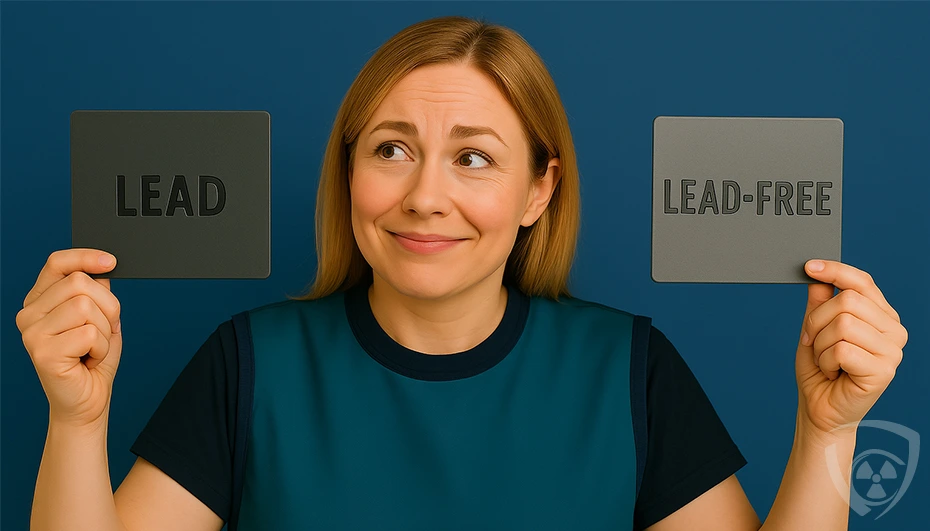
For many years, lead (Lead Vinyl) has been the standard protective material. Its exceptional ability to absorb radiation has made it a preferred choice for manufacturing X-ray aprons, gloves, thyroid shields, and other protective elements. With technological advancements, alternative solutions such as lead-free materials like Edge Bilayer have emerged, offering similar effectiveness while being lighter and more comfortable to use.
How does radiation protection work?
X-ray radiation is a type of electromagnetic wave with a very short wavelength and high energy. Depending on the density and thickness of a given material, radiation can be absorbed, reflected, or pass through it to varying degrees.
The fundamental principles of radiation protection are based on three key factors:
- Distance – the farther from the radiation source, the lower the exposure.
- Exposure time – a shorter duration means a lower dose of radiation.
- Protective shielding – materials with high density effectively block radiation and protect the body.
Various materials are used in radiation protection, but their effectiveness is evaluated based on the radiation attenuation coefficient, expressed in lead (Pb) equivalence. The higher the Pb value, the better the protection.
Lead Vinyl – a classic protective material
Lead has been used in radiation protection for decades. Due to its high density, it is one of the most effective materials for attenuating ionizing radiation.
Structure and properties of Lead Vinyl
Lead Vinyl is a composite material in which lead is embedded in a vinyl matrix. The combination of these two components makes the material flexible and resistant to mechanical damage. Lead provides effective radiation protection, while the vinyl structure enhances its durability.
Protective aprons and shields made from Lead Vinyl are available in various lead equivalence levels, such as 0.25 mm Pb, 0.35 mm Pb, and 0.50 mm Pb. The appropriate choice depends on the level of radiation exposure and the specific nature of the work being performed.
Advantages of Lead Vinyl
Lead Vinyl is highly effective in blocking radiation. It is a long-lasting material, resistant to external factors, and more affordable than alternative solutions. It is widely available and used in various fields, from medical diagnostics to the nuclear industry.
Disadvantages of Lead Vinyl
The main drawback of Lead Vinyl is its heavy weight. Lead is a very heavy metal, which means that protective aprons can cause discomfort during prolonged use. Additionally, lead is a toxic substance and requires proper disposal procedures, which involve additional costs and environmental restrictions.
Edge Bilayer – a modern lead-free alternative
Edge Bilayer is a next-generation protective material developed as an alternative to lead. It is composed of bismuth, antimony, and other heavy metals, which have the ability to attenuate X-ray radiation in a manner similar to Lead Vinyl.
Advantages of Edge Bilayer
The biggest advantage of Edge Bilayer is its low weight. Aprons made from this material can be up to 40 percent lighter than traditional lead-based shields, significantly improving work comfort. Edge Bilayer is also more flexible, allowing for better adaptation of protective clothing to the body.
Another benefit is that Edge Bilayer does not contain lead, meaning there are no toxic waste concerns and disposal is much easier. This allows medical facilities to meet stricter environmental regulations and avoid issues related to hazardous substance compliance.
Is Edge Bilayer as effective as Lead Vinyl?
Studies show that Edge Bilayer can provide protection comparable to traditional lead-based shields, provided that the material has the appropriate thickness. Lead-free aprons with a 0.50 mm Pb equivalence offer similar radiation attenuation properties to their lead counterparts. However, in environments with particularly high radiation exposure, lead remains the more effective solution.
When should you choose Lead Vinyl, and when is Edge Bilayer the better option?
The choice between Lead Vinyl and Edge Bilayer depends on several factors, such as the level of radiation exposure, user comfort, and environmental considerations.
- Lead Vinyl is best suited for environments where maximum protection is required, such as radiology offices, medical diagnostics, and the nuclear industry. It is the best solution when shielding against very high radiation doses is the top priority.
- Edge Bilayer is a better choice for individuals who wear protective aprons for extended periods. Its lower weight and greater flexibility improve work ergonomics. It is also a more environmentally friendly solution, eliminating the toxicity of lead and the high costs of its disposal.
Summary
Both Lead Vinyl and Edge Bilayer have their advantages and disadvantages. Lead remains the standard in radiation protection, but modern lead-free technologies offer better user comfort and a reduced environmental impact.
The choice of the appropriate material should depend on individual needs and the specific application. In the future, we can expect further development of lightweight and eco-friendly protective materials, which will gradually replace traditional lead in radiation protection.


