The 5 most common mistakes in X-ray shielding installation – and how to avoid them
Proper installation of radiological shielding is a key element in creating safe diagnostic rooms, whether in the medical, veterinary, or industrial sectors. Even the best-designed room and highest-quality protective materials will not fulfill their function if they are installed incorrectly or used improperly.
In practice, small but significant oversights often occur during the implementation stage. Their consequences can be serious – from complications during technical inspections to real risks to users’ health and safety. Below, we describe the five most common mistakes that occur during the installation of X-ray shielding – and present ways to effectively avoid them.
Mistake 1: Planning the installation of X-ray shielding too late
Incorrect placement of radiological protection in the project schedule
In many cases, the topic of radiation protection is brought up only at the final stage of finishing works. Among investors or contractors, there is a common belief that X-ray shielding can be “installed at the end,” once the entire room infrastructure is complete. This approach carries a serious risk of protective elements being mismatched to the specific layout of the space.
Delayed planning often results in:
- the selection of inappropriate solutions – for example, X-ray shields that are too large to fit between the equipment and the wall;
- lack of space for proper installation of X-ray glass – especially if no recess or room for frames has been planned;
- the need for additional modifications to walls, door frames, or ceilings, which generates unnecessary costs and delays the completion of the project.
Including X-ray shielding already at the design stage helps avoid such problems and significantly simplifies the installation process, while also increasing the chances of a quick and hassle-free technical inspection of the room.
Mistake 2: Incorrect installation of X-ray glass
A lead glass is not an ordinary glass – it requires special attention
Lead X-ray glass serves as a protective glazed barrier, allowing for the safe observation of the patient or diagnostic area. Its shielding properties come from the lead oxide content within the glass, which is why the installation of these components must follow specific guidelines.
One of the most serious mistakes is the incorrect placement of the X-ray glass – particularly in the case of asymmetric panes, where the leaded layer is not evenly distributed. There are instances where the glass is installed in reverse, which can result in reduced shielding effectiveness or non-compliance with regulatory standards.
Other significant errors include:
- using standard window frames that do not ensure shielding continuity at the junction with the wall,
- failing to seal the gaps around the X-ray glass,
- applying mounting foams or silicones that do not provide proper sealing against ionizing radiation.
It’s important to remember that even a millimeter-wide gap around the glass can become a weak point in the shielding, allowing radiation to pass through. As a result – despite using high-quality glass – the protection becomes ineffective.
Mistake 3: Discontinuity of shielding in walls and corners
Radiation penetrates where we least expect it
Shielding of X-ray rooms is based on the principle of complete barrier continuity – meaning that every surface through which radiation could pass must be secured with a material of appropriate attenuation properties. In practice, however, this continuity is often disrupted.
The most common installation errors include:
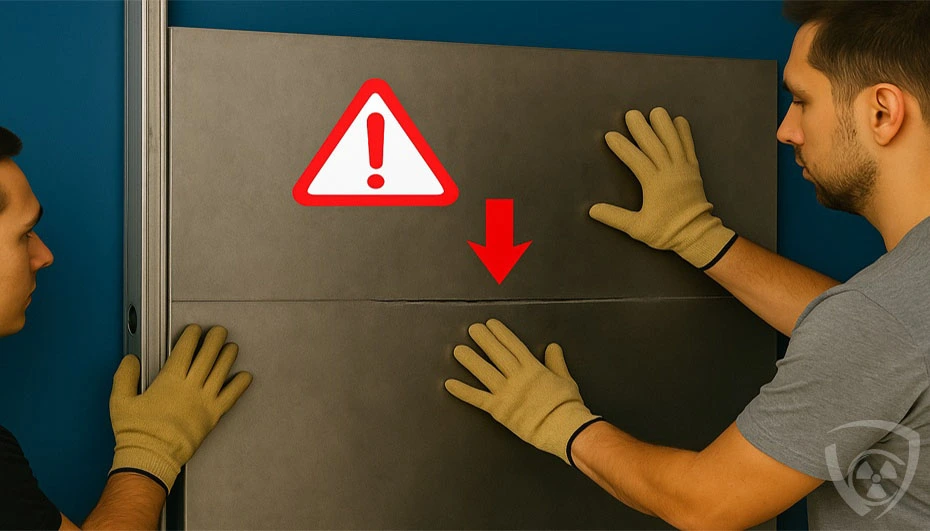
- no overlapping between sheets of lead foil or panels,
- joining the material edge-to-edge, which creates micro-gaps,
- insufficient shielding of wall corners and transitions between walls and ceilings or floors.
Particularly dangerous are areas that are hard to access or seemingly insignificant – such as recesses, spaces behind technical equipment, or zones above suspended ceilings. These are often the spots where leaks occur, which are difficult to detect and can lead to prolonged exposure of personnel.
To maintain continuous shielding, protective overlays, appropriate lead tapes, or corner-securing structures should be used. It is also crucial that all technical penetrations – such as ventilation ducts or cable passages – are properly sealed in accordance with radiological protection guidelines.
Mistake 4: Choosing the wrong lead thickness
Not every 0.5 mm Pb shield will do the job
One of the most fundamental parameters of shielding materials is their lead thickness, expressed in millimeters of lead (mm Pb). This value determines how effectively a material attenuates ionizing radiation. Unfortunately, selecting the wrong thickness is one of the most common mistakes – made by both those ordering the materials and the installation teams.
The most common mistakes include:
- using 0.5 mm Pb thickness in areas where 1.0 mm Pb or more is required (e.g. when dealing with higher X-ray tube voltages),
- failing to distinguish between physical thickness and the so-called lead equivalent – especially in the case of composite or lead-free materials,
- not accounting for the effect of the angle of radiation incidence on the shielding effectiveness.
It’s important to note that the shielding thickness should always be tailored to the specific technical conditions – including the type of X-ray device, exposure parameters, and the position of walls in relation to the radiation source. Skipping this step may result in an entire wall covered with lead foil or X-ray lead panels being ineffective.
Using shielding that is too thin may lead to the need for dismantling, reinforcing the barrier with additional layers, or even complete replacement – all of which can result in significant costs and project delays.
Mistake 5: Lack of documentation and certification for protective products
Without proper documentation, the X-ray room will not pass inspection
All components of radiological protection intended for use in medical facilities must meet specific quality and safety standards. This applies to X-ray glass, lead foil, X-ray shields, lead-lined doors, and fixed shielding panels. Unfortunately, some investors choose to purchase the cheapest available products – often without verifying whether they come with the required technical documentation.
The absence of such documentation results in:
- issues during technical inspection by Sanepid, a radiation protection officer, or the National Atomic Energy Agency (PAA),
- the need for additional testing or expert evaluations to confirm the effectiveness of the shielding,
- the risk that the product does not meet the declared protective parameters.
The basic documents that every X-ray shielding component should include are:
- a declaration of conformity with the PN-EN 61331-1 standard (applies to both personal and structural shielding),
- a product datasheet including information about the material, thickness, dimensions, and protection class,
- a certificate confirming the effectiveness of protection against ionizing radiation.
Purchasing products without these documents poses not only a financial risk, but more importantly, legal and health risks. It’s important to remember that the responsibility for ensuring the shielding meets the applicable standards lies with the entity building the X-ray room – which is why the documentation must be complete and kept for the entire period of use.
Summary
Effective radiological protection is not only about using the right materials but also about proper installation, planning, and compliance with legal requirements. As the examples above show, installation errors can occur at many stages of the project – from design, through delivery, to final construction works.
It is important to remember that radiation protection requires special care. Even minor mistakes – such as improperly installed glass, inaccurate overlapping of lead foil, or missing certification – can significantly affect the safety of users and the proper functioning of the diagnostic room.
When planning an X-ray-related investment, it is therefore essential to ensure that every stage – from design to execution – is carried out with full responsibility and knowledge of technical requirements. A well-thought-out installation guarantees effective protection and peace of mind for years to come.