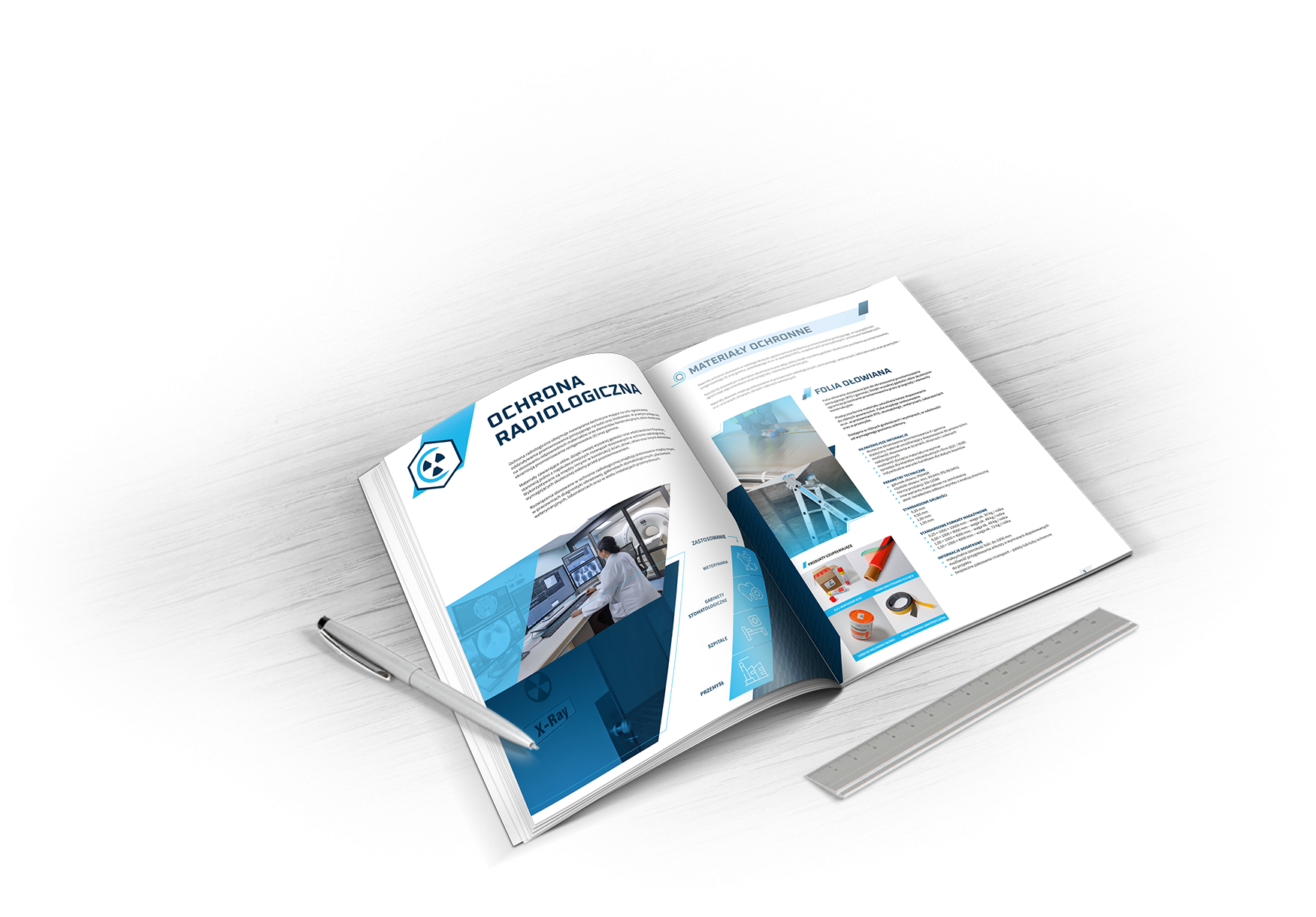
How to read technical documentation for radiation protection products? Certificates, standards, and mm Pb markings

Purchasing radiation protection products should not be based solely on price, product photos, or a short description in an online store. In the case of materials such as lead sheet, lead foil, X-ray glass, protective screens, X-ray doors, or personal protective equipment, technical documentation is extremely important. It allows you to verify whether a given product actually meets the requirements of a specific application.
Technical documentation may seem difficult, especially for people purchasing radiation protection products for the first time. It often includes terms such as mm Pb, lead equivalence, nominal thickness, dimensional tolerance, application range, material type, compliance with standards, certificate, declaration of conformity, or technical data sheet. In practice, however, many of these details are quite easy to understand once you know what to look for.
In this article, we explain how to read technical documentation for radiation protection products, what the most important parameters mean, and why it is worth choosing products supplied with proper documentation.
Why is technical documentation so important for radiation protection products?
Radiation protection products have a specific purpose: reducing exposure to ionizing radiation. These are not ordinary construction materials or standard equipment components. Even if they look simple from the outside, their effectiveness depends on technical parameters, thickness, the type of material used, installation method, and proper selection for the intended working conditions.
Technical documentation helps answer several basic questions:
- what material the product is made of,
- what its protective equivalence is,
- what application it is intended for,
- what its dimensions and tolerances are,
- whether it has a certificate or declaration of conformity,
- what the conditions for use, transport, and storage are.
Without this information, it is difficult to reliably compare two products. For example, two X-ray protective shields may look similar but differ in lead equivalence, weight, manufacturing method, durability, or intended application. Likewise, lead foil with the same thickness may vary in surface finish, adhesive layer type, or suitability for specific types of work.
What should technical documentation for a radiation protection product include?
The scope of technical documentation depends on the type of product. Documentation for a material such as lead sheet will differ from documentation for lead glass, and both will differ from documentation for an X-ray apron or protective screen. Nevertheless, there are several elements that should always be checked.
Product name and type
The documentation should begin with a clear product name. It is also beneficial if the document specifies the type, model, variant, or exact thickness. This is especially important when a company offers several similar products, for example lead sheet in different thicknesses, standard and self-adhesive lead foil, or X-ray protective screens with or without a window.
The product name in the documentation should match the information shown in the offer, invoice, or order. If a customer orders self-adhesive lead foil with a thickness of 0.5 mm Pb, the documentation should not refer to a different variant, thickness, or product intended for another application.
Material composition
The second important element is the description of the material composition. In radiation protection products, this may include lead, lead glass, lead-free material, plastic containing radiation-absorbing substances, steel, aluminum, structural boards, or a combination of several materials.
In the case of products such as lead sheet and lead foil, the key factors are the lead itself and its thickness. For X-ray glass, the important parameters include the lead equivalence of the glass, its dimensions, total thickness, and intended application. For X-ray aprons, the protective material, type of outer covering, size, and level of protection are all important.
Dimensions and tolerances
Technical documentation should include the product dimensions. These may refer to the dimensions of a sheet, roll, protective screen, glass panel, door, apron, or another component. In practice, not only the nominal value is important, but also the dimensional tolerance.
Tolerance means the permissible deviation from the declared dimensions. In technical products, this is a normal occurrence. For example, a material may have declared dimensions of 1000 × 2000 mm, but with a specified manufacturing tolerance. This information is particularly important during installation, cutting, and fitting protective shielding to a specific surface.
Thickness and protective equivalence
One of the most important parameters in radiation protection is the thickness or protective equivalence expressed in mm Pb. In technical documentation, it is important to check whether the stated value refers to the physical thickness of the material or to the lead equivalence.
This is a very important distinction. Physical thickness indicates how many millimeters thick the material actually is. Lead equivalence, on the other hand, describes the level of protection the product provides compared to a lead layer of a specific thickness.
What does mm Pb mean in radiation protection product documentation?
The mm Pb marking is one of the most common parameters found in radiation protection product documentation. The abbreviation Pb stands for lead, and mm Pb means millimeters of lead. In practice, this parameter indicates the protective equivalence provided by a given product.
For example, a 0.5 mm Pb marking means that the product provides protection equivalent to a lead layer with a thickness of 0.5 mm. A 1.0 mm Pb marking indicates a higher level of protection, equivalent to a lead layer with a thickness of 1.0 mm.
In the case of materials made directly from lead, such as lead sheet or lead foil, the material thickness is often directly related to the level of protection. However, in products made from other materials, such as lead-free solutions, the lead equivalence may be achieved through a special material composition.
Why is looking only at thickness not enough?
Not every product with a similar physical thickness provides the same level of protection. For example, an X-ray apron made from lead-free material may have a different overall thickness than a lead apron, yet both can offer the same protective equivalence. Likewise, lead glass is not evaluated solely by the total thickness of the panel, but primarily by its declared level of protection.
For this reason, technical documentation should include not only information about thickness, but above all the protective equivalence. If a product is intended for radiation protection, descriptions such as “thick,” “solid,” or “heavy” are not sufficient technical information.
Certificate, declaration of conformity, and technical data sheet – what are the differences?
In conversations with customers, terms such as certificate, approval, technical data sheet, declaration of conformity, and product documentation are often used. These terms do not always mean the same thing. It is worth understanding the basic differences, as each of these documents may serve a different purpose.
Product technical data sheet
A technical data sheet is a document describing the most important product parameters. It may include information about the material, dimensions, thickness, weight, method of use, storage conditions, application range, and limitations. A technical data sheet is especially useful for people responsible for product selection, installation, or operation.
For products such as lead sheet, the technical data sheet may specify the thickness, surface weight, format, material purity, or intended application. For products such as lead foil, the document may additionally provide information about the type of adhesive, protective layer, or application method.
Product certificate
A certificate is a document confirming specific product properties. It may relate to the level of protection, compliance with a standard, test results, or parameters declared by the manufacturer. In radiation protection, a certificate is highly important because the customer wants to be sure that the product not only looks like protective shielding, but actually meets specific protection requirements.
It is worth checking whether the certificate applies exactly to the product being purchased. If an X-ray protective screen with a specific protective equivalence is being ordered, the document should refer to that exact variant, rather than to a general product group without specifying the parameters.
Declaration of conformity
A declaration of conformity is a document in which the manufacturer or supplier declares that the product meets specific requirements. Depending on the type of product, it may refer to standards, directives, regulations, or technical specifications.
A declaration of conformity does not always replace a test certificate. However, it can be a very important part of the documentation, especially when the product is intended for a medical facility, dental office, diagnostic laboratory, industrial plant, or another environment where documentation for purchased protective shielding is required.
How to read technical documentation for lead sheet?
Lead sheet is one of the basic materials used in radiation protection. It is commonly used for shielding walls, doors, partitions, structural elements, fixed barriers, and custom technical solutions. The documentation for such a product should be clear and specific.
When analyzing the documentation for lead sheet, it is worth paying attention to several parameters:
- sheet thickness, e.g. 0.5 mm, 1.0 mm, 1.5 mm, or 2.0 mm,
- dimensions of the sheet or roll,
- material weight or weight per 1 m²,
- material purity or composition, if specified,
- intended application of the product,
- information about cutting options or custom sizing.
It is worth remembering that lead sheet is a heavy material. The greater the thickness, the greater the weight, which is important for transport, installation, and structural planning. For example, 1 m² of lead with a thickness of 1 mm weighs approximately 11.3 kg. This information may be important when calculating material requirements and planning installation work.
If the customer needs the material specifically for radiation protection, they should check whether the documentation and product description refer to X-ray applications. More information about available materials and shielding solutions can be found in the radiation protection section on the Coradika website, where products designed for radiation shielding are available.
Lead sheet 0.5 mm, 1 mm, or 2 mm – what does the thickness mean?
The thickness of lead sheet has a direct impact on its weight and potential level of protection. However, this does not mean that the thickest material should always be chosen. The selection should depend on the shielding design, type of equipment, working conditions, room layout, and requirements defined by the person responsible for radiation protection.
In practice, thinner lead sheet may be used where protection requirements are lower or where it forms part of a larger shielding system. Thicker lead sheet may be necessary for higher protection requirements or industrial applications.
How to read technical documentation for lead foil?
Lead foil is a material that can be used in places where flexibility, easier surface adaptation, or quick application is required. A special variant is self-adhesive lead foil, which features an adhesive layer that simplifies installation on selected surfaces.
When reviewing the documentation for lead foil, it is worth checking:
- foil thickness,
- dimensions of the roll or sheet,
- whether the foil has a self-adhesive layer,
- type of surface protection,
- installation recommendations,
- storage conditions,
- intended use for radiation protection or other applications.
In the case of self-adhesive lead foil, information about application is very important. The surface should be properly prepared, clean, dry, and stable. An unsuitable substrate may reduce the durability of the installation, even if the foil itself has the appropriate protective properties.
Lead foil vs. lead sheet – is the documentation significantly different?
The documentation for both products may contain similar information, such as thickness, dimensions, weight, and intended use. The difference is that documentation for lead foil more often includes information related to flexibility, adhesive type, protective layer, and application method. For lead sheet, more important parameters may include format, weight, cutting methods, and mechanical installation.
In practice, the choice between these materials should depend on the intended application. Lead sheet may be a better option for larger flat surfaces and heavier shielding solutions, while lead foil is more suitable where easier adaptation or installation on a specific component is required.
How to read technical documentation for X-ray glass?
X-ray glass, also referred to as lead glass or leaded glass, is used where both radiation protection and visibility of the patient, process, or workstation are required. The documentation for X-ray glass should be particularly detailed, as both protective and optical properties are important.
When reviewing X-ray glass documentation, attention should be paid to:
- lead equivalence, e.g. 1.5 mm Pb, 2.0 mm Pb, or another value,
- glass dimensions,
- total glass thickness,
- light transmission, if specified,
- installation recommendations,
- information about glass edges and protection,
- compliance with requirements for the intended application.
It is worth remembering that the mere presence of glass in a partition does not guarantee radiation protection. X-ray rooms require specialized lead glass with a specified protective equivalence. Ordinary glass does not provide the same level of protection as X-ray glass.
How to read technical documentation for X-ray protective screens?
X-ray protective screens are ready-made shielding solutions that can be used in medical facilities, clinics, treatment rooms, veterinary practices, or other places where mobile or workstation radiation protection is required. The documentation for a protective screen should describe both its protective and structural properties.
For X-ray protective screens, it is important to check:
- lead equivalence of the entire shield,
- dimensions of the protective screen,
- whether the screen includes an X-ray viewing window,
- dimensions and protective equivalence of the window,
- material used for the frame construction,
- stability and mobility,
- product weight,
- conditions of use.
If the protective screen includes a window, the documentation should clearly specify that the window also provides the appropriate protective equivalence. Sometimes customers focus mainly on the lower part of the screen and forget that the window must also fulfill a protective function.
Why does the weight of a protective screen matter?
The weight of a protective screen affects stability, transport, ease of movement, and safety during use. A screen with lead shielding will be heavier than a standard visual partition. For this reason, the technical documentation should include information about the product weight, especially if the screen is intended to be moved frequently.
How to read technical documentation for X-ray doors?
X-ray doors are one of the key elements in protecting radiology rooms. Even if the walls are properly shielded, incorrectly selected doors can become the weak point of the entire barrier. Therefore, door documentation should include both protective and structural parameters.
For X-ray doors, it is worth checking:
- protective equivalence of the door leaf,
- type of shielding core used,
- door dimensions,
- type of door frame,
- method of protecting joints and edges,
- possibility of using X-ray glazing,
- installation recommendations.
In the case of X-ray doors, continuity of protection is extremely important. The presence of lead in the door leaf alone is not sufficient if the areas around the frame, gaps, or glazing are not properly shielded. For this reason, the technical documentation and installation design should always be analyzed together.
How to read technical documentation for personal radiation protection equipment?
Personal radiation protection equipment, such as X-ray aprons, thyroid collars, protective glasses, gloves, or partial shielding products, should also include technical documentation. In this case, not only the level of protection is important, but also ergonomics, size, intended use, and method of use.
For X-ray aprons and similar products, it is worth checking:
- protective equivalence, e.g. 0.25 mm Pb, 0.35 mm Pb, or 0.5 mm Pb,
- type of protective material,
- size and design,
- area of the body covered by protection,
- product weight,
- storage method,
- recommendations for technical condition inspections.
It is worth remembering that personal radiation protection equipment is used directly by medical staff or patients. For this reason, in addition to protective parameters, comfort of use, proper fit, and the technical condition of the product are also important. Even a product with a good protective equivalence will not fulfill its function if it is damaged, improperly stored, or incorrectly sized.
Most common mistakes when reading technical documentation for radiation protection products
Technical documentation is often ignored or reviewed only superficially. This can lead to purchasing mistakes, installation problems, or choosing a product that does not meet actual requirements. Below, we discuss the most common mistakes.
Confusing physical thickness with protective equivalence
This is one of the most important mistakes. A customer sees information about the material thickness and assumes it represents the level of protection. In reality, for many products it is necessary to check whether the documentation refers to the physical thickness or the lead equivalence. In the case of materials such as lead sheet, the relationship is more direct, but for composite materials, glass, and protective clothing, greater caution is required.
Comparing products based only on price
Two products may have similar names but different parameters. A lower price may result from a lower protective equivalence, different construction, lack of additional features, simpler manufacturing, or limited documentation. In radiation protection, comparing products solely by price is risky, because the most important factor is whether the product meets the required technical specifications.
Failing to verify what exactly the certificate applies to
A certificate should refer to a specific product or product group that actually includes the ordered variant. If the document applies to a different model, thickness, or protection range, it may not be sufficient confirmation for the purchased product.
Ignoring installation information
Even the best material may fail to perform its function if installed incorrectly. This applies especially to shielding walls, doors, windows, corners, and joints. The documentation may contain important information regarding surface preparation, overlaps, joints, fastening methods, or storage.
What should you pay attention to when purchasing radiation protection products?
Before making a purchase, it is worth preparing basic information about the intended application. This makes product selection easier and helps avoid misunderstandings. For larger projects, it is advisable to consult the choice with a radiation protection specialist or a designer of fixed shielding systems.
When purchasing radiation protection products, it is worth paying attention to:
- whether the product has a specified protective equivalence,
- whether the supplier provides technical documentation,
- whether the product parameters match the project requirements or recommendations,
- whether the product is available in the required dimensions,
- whether it can be custom-made to size,
- whether the supplier offers assistance with product selection,
- whether certificates or documents confirming the product parameters are included.
When purchasing online, it is worth choosing trusted sources. Radiation protection products, X-ray accessories, and specialized materials can be found, among others, in the Coradika store, where the offer is intended for customers looking for radiation shielding solutions.
Why is documentation important for medical facilities and companies?
Medical facilities, dental clinics, veterinary practices, diagnostic laboratories, industrial plants, and research laboratories often need to demonstrate that the solutions they use meet specific requirements. Technical documentation may be necessary not only at the purchasing stage, but also during inspections, room approvals, facility modernization, or when preparing internal documentation.
The absence of documentation can make it difficult to assess whether a product is actually suitable for a specific application. It may also create problems when comparing offers, verifying parameters, or planning future purchases. For this reason, it is worth keeping documentation together with invoices, shielding designs, and other materials related to the facility.
Documentation and responsibility for product selection
The supplier can assist in selecting the product, explain the parameters, and present available solutions. However, the final choice of radiation protection should be based on actual technical requirements, project specifications, working conditions, and recommendations from persons responsible for radiation safety. Technical documentation is a tool that helps make informed decisions throughout this process.
How does technical documentation help compare offers?
When comparing offers for radiation protection products, it is important to evaluate not only the price, but also the technical parameters. Well-prepared documentation makes it possible to quickly verify whether the offers actually concern the same product or a similar level of protection.
For example, when comparing offers for lead sheet, it is worth checking the thickness, format, weight, price per square meter, cutting options, and availability of certificates. When comparing offers for lead foil, it is also important to verify whether it is self-adhesive, what type of adhesive it uses, whether it has a protective layer, and for which surfaces it is intended.
Specialized information about materials such as lead sheet may be helpful when analyzing applications, thicknesses, and technical parameters required for proper product selection.
What information should be provided to the supplier before purchase?
The more specific information the supplier receives, the easier it will be to select the right product. This is especially important for custom orders, made-to-measure products, and materials intended for specialized applications.
Before sending an inquiry, it is worth preparing:
- the type of product being searched for,
- the required protective equivalence or thickness,
- dimensions,
- intended application area,
- information on whether the product should be custom cut to size,
- expected delivery timeframe,
- requirements regarding documentation and certificates.
In the case of shielding X-ray rooms, a fixed shielding design or guidelines from a radiation protection inspector can be very helpful. This allows the supplier to refer to specific requirements instead of guessing what level of protection will be appropriate.
What should you do if the documentation is unclear?
If the technical documentation raises any doubts, it is worth asking the supplier for clarification before making a purchase. It is better to clarify the parameters in advance than to discover after delivery that the product does not meet expectations. A professional supplier should be able to explain what the document refers to, what the parameters mean, and what limitations the product may have.
It is worth asking questions such as:
- Does the stated value refer to the material thickness or the lead equivalence?
- Does the certificate apply exactly to this product variant?
- Is the product suitable for X-ray applications?
- Is it possible to manufacture the product to custom dimensions?
- How should the product be stored and installed?
A lack of clear answers may be a warning sign. In the radiation protection industry, precision is extremely important, which is why documentation and communication should be as specific as possible.
Technical documentation and user safety
Technical documentation is not just a formality. It has a real impact on the safe use of radiation protection products. It allows users to verify whether the product meets the required standards, how it should be used, and what should be avoided during installation or operation.
For example, lead foil may require proper surface preparation, while lead sheet may require appropriate edge protection and stable installation. An X-ray apron should be stored correctly, preferably in a way that minimizes the risk of bending and damaging the protective material. X-ray glass must be installed according to its intended use in order to maintain continuous protection throughout the entire barrier.
Summary – how to consciously read technical documentation for radiation protection products?
Reading technical documentation for radiation protection products does not have to be difficult if you know which information is the most important. First of all, you should check the product name, material composition, dimensions, thickness, protective equivalence, certificate, declaration of conformity, and recommendations for use. Special attention should be paid to the mm Pb marking, as it often indicates the level of radiation protection.
When purchasing products such as lead sheet, lead foil, X-ray glass, protective screens, X-ray doors, or personal protective equipment, it is not advisable to focus only on price. Technical parameters, documents confirming product properties, and the possibility of receiving assistance with product selection are equally important.
Well-prepared technical documentation makes it easier to compare offers, reduces the risk of incorrect purchases, and increases user safety. This is especially important in the radiation protection industry, where every shielding component should be selected consciously and according to the requirements of a specific application.
When choosing radiation protection products, it is worth selecting suppliers who clearly describe product parameters, provide technical documentation, and help customers understand exactly what they are purchasing. This ensures that the purchase is not random and that the selected product better meets the actual needs of a laboratory, clinic, industrial facility, or medical institution.