Best uses of GK-RTG protective panels in an x-ray room

GK-RTG protective panels are among the materials that determine whether an X-ray room meets radiation protection requirements or merely looks as though it does. The difference is not visible to the naked eye: it lies in the thickness of the lead layer concealed within the gypsum plasterboard. This article explains what these panels are, how to compare them and how to choose the right variant for a specific project, from a dental practice to a diagnostic imaging room.
In practice, GK-RTG boards are sometimes chosen as casually as an ordinary finishing material. This is a mistake that may only become apparent during an acceptance inspection by the State Sanitary Inspectorate or during radiation measurements after installation. A properly selected panel means the right Pb equivalence, a suitable size, verified documentation and continuous shielding at every joint. The Coradika Radiological Protection Centre supplies certified GK-RTG protective panels with complete documentation, both for hospitals undertaking full X-ray room conversions and for contractors who need materials ready for acceptance.
What is a GK-RTG panel, and how does it differ from ordinary plasterboard?
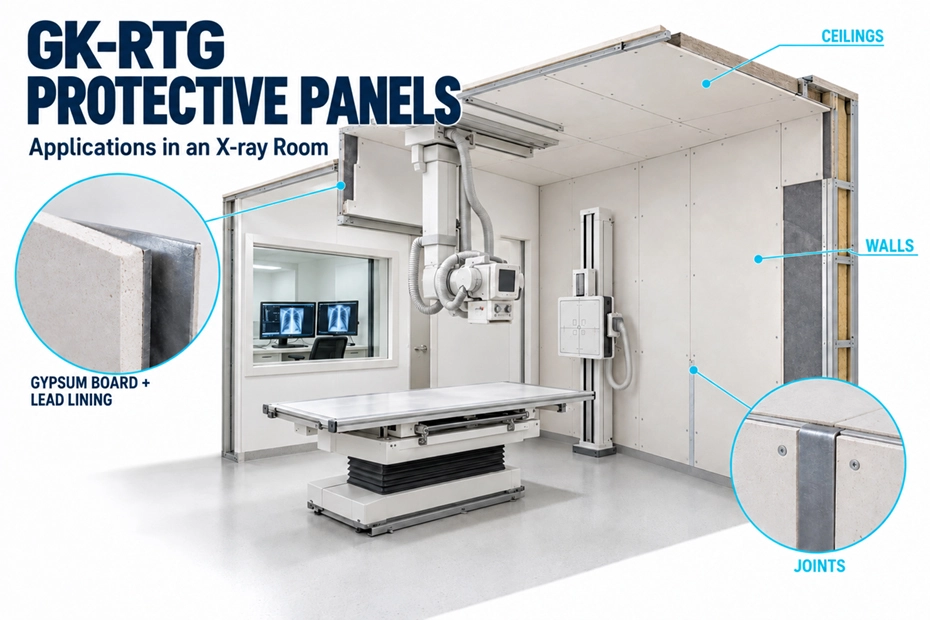
A standard GK-RTG board has a 12.5 mm gypsum plasterboard core containing lead foil or a barium sulphate insert. This construction allows the board to serve as a wall finish while providing the required radiation protection. Compared with lead sheet bonded to a wall or a wall made of baryte concrete, GK-RTG boards offer one clear advantage: they can be installed quickly and easily in existing rooms without extensive reconstruction.
An alternative to a lead layer is a core enriched with barium sulphate, commonly referred to as baryte. A baryte board provides protection equivalent to approximately 0.8 to 1.2 mm Pb per layer, which is often sufficient for typical dental practices or light diagnostic applications. Baryte is sometimes chosen where a project rules out lead for environmental reasons or where ease of installation is the priority. A lead-foil variant is preferred when the shielding design calls for a precisely specified, higher Pb equivalence. In that case, the lead foil makes it easier to document the declared equivalence and obtain a 3.1 inspection certificate confirming the specific thickness of the protective layer.
Protective parameters: what does lead thickness expressed in mm Pb actually mean?
The unit mm Pb, or millimetres of lead equivalence, provides a common basis for designing and comparing radiation shielding. Different materials can provide the same level of protection, but expressing their performance in mm Pb makes it possible to compare them with each other and with the design requirements. The overall thickness of a board is therefore not a measure of its shielding performance; what matters is its declared lead equivalence.
Panels available on the Polish market come in 0.5, 1.0, 1.5, 2.0, 2.5 and 3.0 mm Pb variants. Their use in specific applications can be outlined as follows:
- 0.5 mm Pb: dental practices and low-workload rooms with less demanding X-ray equipment.
- 1.0 mm Pb: standard diagnostic imaging rooms; a typical starting point for many shielding designs.
- 1.5 to 2.0 mm Pb: higher room workloads, higher X-ray tube voltages and rooms adjoining areas where people remain for extended periods.
- 2.5 to 3.0 mm Pb: specialist applications, intensively used rooms and projects with demanding dose limits.
The final thickness must always follow a shielding design prepared by a radiation protection officer and calculations under a standard, most commonly PN-86/J-80001. Although withdrawn in 2012, this standard is sometimes still used as a basis for calculations accepted by Poland’s National Atomic Energy Agency. The list above is a starting point for a discussion with the designer, not a basis for making an independent design decision. No amount of common-sense selection can replace a design supported by calculations.
Where do GK-RTG protective panels work best?
In healthcare, GK-RTG panels are used primarily when existing rooms are converted into diagnostic imaging rooms, X-ray rooms and dental practices. They are fitted to walls and ceilings and around door openings. Their main advantage is that the required Pb equivalence can be achieved without building a baryte concrete wall, which takes up considerably more space and requires more time to construct. One important distinction: an X-ray protective door panel is a separate product category with different installation requirements. It should not be treated as an ordinary wall panel.
Outside healthcare, protective X-ray boards can be used in non-destructive testing laboratories, industrial radiography stations and production lines with X-ray quality-control systems. Industrial requirements often differ from medical ones and may call for thicker lead layers or a combination of boards and other fixed shielding. The available formats and ease of cutting GK-RTG boards make it possible to adapt the shielding to unusual room layouts, which would be considerably harder and more expensive with baryte concrete.
Choosing the right panel: dimensions, weight and compatibility with the design
Standard formats available on the Polish market include 625 × 2,000 mm and 600 × 2,000 mm. A width of 625 mm is narrower than the typical 1,200 mm width of ordinary plasterboard, which helps fit panels to protected areas and reduces the need for cutting when lining walls. A 600 × 2,000 mm board with a 1.0 mm Pb layer weighs approximately 27 kg; a 625 × 2,000 mm board with a 1.5 mm Pb layer weighs approximately 31 kg. This has a direct impact on transport and installation: heavier boards require two people to handle them and careful planning of the work sequence.
In practice, minimum pallet deliveries usually comprise around 20 boards and 20 m². Ordering an allowance during the planning stage is more economical than ordering extra boards later. Every additional shipment brings another transport cost and a risk of delaying the installation schedule, especially when the room’s acceptance date is fixed. Indicative prices on the Polish market range from approximately PLN 279 per m² for a 0.5 mm Pb variant to approximately PLN 699 per m² for a 2.0 mm Pb variant, although the final price depends on the supplier, sales channel and order quantity.
A GK-RTG panel is one element of a shielding system that must work together with X-ray doors, lead glass and, where applicable, protective screens. The key principle is a consistent level of Pb equivalence around the entire room: one area with a lower equivalence can undermine the rest of the shielding. The panel supplier should therefore also offer complementary components, such as doors, glazing and possibly screens, or at least provide the technical information needed to design shielding without gaps or radiation leakage paths.
Installing GK-RTG protective panels: requirements and costly mistakes
Structural requirements
Standard installation follows the principles of dry construction: a steel stud frame, system screws to secure the panels, and jointing and filling. GK-RTG boards, however, also have requirements specific to radiation protection. Heavier variants, from 1.5 mm Pb upwards, require a closer-spaced frame with studs no more than 400 mm apart, as well as reinforcement or chemical anchors where heavy components are fixed. For the 2.0 mm Pb variant, an overlap of 25 to 30 mm at joints and lead tape over fixing points are required.
Common installation mistakes
The most common faults that lead to comments during acceptance include:
- Fixing panels at the edges rather than close to the structural studs, causing the boards to deform.
- Overtightening screws and damaging the board structure and lead layer.
- Failing to reinforce heavier Pb variants, particularly on ceilings and around doors.
- Joining panels incorrectly and leaving gaps in the shielding.
Continuity of shielding matters more than the thickness of the material alone. A single gap at a joint can undermine the effectiveness of an entire wall made from correctly specified panels. Before the room is accepted, it is worth asking a radiation protection officer to check for gaps, carry out radiation measurements and identify any areas that need further shielding before the sanitary authorities inspect the room.
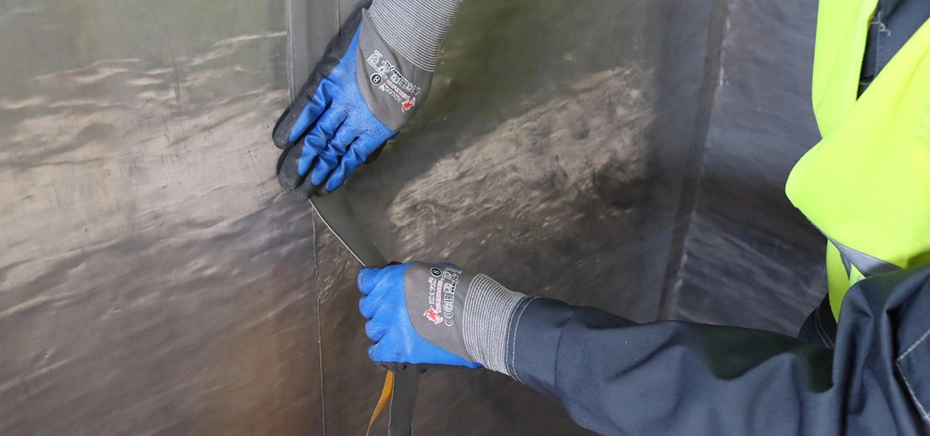
To shield joints and gaps between GK-RTG panels, self-adhesive lead tapes can be used, provided they are selected in accordance with the shielding design and the panel installation instructions.
Certificates, standards and what to request from a supplier
When buying GK-RTG panels, you should expect a complete set of documents: a Declaration of Performance for the construction product, CE marking, a 3.1 inspection certificate for the lead layer and a technical data sheet stating the declared Pb equivalence. The shielding design prepared by the radiation protection officer must be based on specific manufacturer data. A technical data sheet stating the mm Pb values is therefore essential, not optional. A panel without full documentation may complicate acceptance of the room by the State Sanitary Inspectorate and delay commissioning of the X-ray equipment.
The documents needed when an X-ray room is accepted cover more than the equipment and the shielding design. They also include evidence of the properties of the shielding materials used. The inspector will check whether the installed boards match the design documentation, while radiation measurements will show whether the shielding performs as calculated. Recording the shielding layers during installation, taking photographs before they are covered and keeping the material specifications are practices that can save time during acceptance.
The Coradika Radiological Protection Centre offers protective X-ray boards in a range of Pb thicknesses and formats, with complete compliance documentation, a Declaration of Performance, CE marking and a 3.1 inspection certificate. These products are suited to hospital projects as well as conversions of individual rooms carried out by contractors. If you are preparing an enquiry, contact our team and provide the key details: the Pb thickness specified in the shielding design, the estimated area, the required board format and the delivery deadline. We will prepare an offer that includes the documentation, not just a price per square metre.
What to take away before placing an order
A GK-RTG panel may be straightforward to install, but selecting the right one requires care. The key factors are the Pb thickness specified by the shielding design, a format suited to the site’s logistics and documentation that will support sanitary acceptance. None of these elements can replace another; overlooking any one of them can undo the work invested in the rest.
Before placing an order, make sure you have a shielding design with calculations, know the required Pb thickness for each barrier and understand which complementary components will be needed, such as doors, glazing and possibly protective screens. If any of these elements is missing, start with a consultation rather than buying materials. Following this sequence helps avoid costly corrections after acceptance. Checking the design and documentation for GK-RTG protective panels before ordering is the shortest route to a smooth room acceptance process.
GK-RTG protective panels with various lead layer thicknesses can be conveniently ordered from the Coradika online store.