Lead Sheet in Non-Destructive Testing (NDT) – Radiation Protection in Industry
Non-destructive testing (NDT) enables the quality of materials and industrial structures to be assessed without damaging them. In industrial radiography, which uses X-ray or gamma radiation, properly designed radiation shielding plays an essential role. One of the materials used for this purpose is lead sheet for radiation protection and industrial applications, which, thanks to its high density and shielding properties, effectively reduces the transmission of ionizing radiation.
What is non-destructive testing (NDT) and why is it important in industry?
Non-destructive testing, internationally referred to as NDT (Non-Destructive Testing), includes methods that allow the technical condition of materials, structures, and equipment to be assessed without affecting their suitability for further use. It is an important part of quality control in many industrial sectors, particularly where operational safety depends on the strength and reliability of the components used.
NDT techniques are employed, among other applications, to inspect welded joints, castings, pipelines, pressure vessels, and structural steel components. They make it possible to identify material imperfections that could lead to damage, failure, or a reduction in the service life of the finished product.
The most commonly used non-destructive testing methods include:
- Visual testing (VT) – enables the assessment of material surfaces and the detection of visible imperfections.
- Ultrasonic testing (UT) – uses ultrasonic waves to locate internal discontinuities.
- Magnetic particle testing (MT) – is used to inspect selected ferromagnetic materials.
- Penetrant testing (PT) – makes it possible to detect discontinuities open to the surface of the tested component.
- Radiographic testing (RT) – uses X-ray or gamma radiation to analyze the internal structure of materials.
These methods differ in their operating principles, areas of application, and technical requirements. Not all of them require radiation shielding. Special protective measures are necessary during radiographic testing, where sources of ionizing radiation are used.
Industrial radiography – why does it require appropriate radiation protection?
Industrial radiography is a non-destructive testing method that allows the internal structure of components to be examined without cutting or dismantling them. As radiation passes through the tested material, it is attenuated depending on the material’s thickness, density, and any discontinuities present.
The resulting radiographic image may reveal defects that are invisible during ordinary visual inspection, including gas porosity, welding imperfections, voids, and certain internal cracks.
This type of testing is primarily used in:
- the energy and petrochemical industries,
- steel structure manufacturing,
- industrial pipeline inspection,
- mechanical engineering and foundry operations,
- pressure vessel manufacturing,
- quality control of components subject to particularly demanding requirements.
Depending on the technology, X-ray generators or equipment containing radioactive sources that emit gamma radiation are used.
Both solutions require compliance with radiation protection principles. Ionizing radiation can pose a health risk, making it essential to limit the exposure of workers and other people in the vicinity of the testing area.
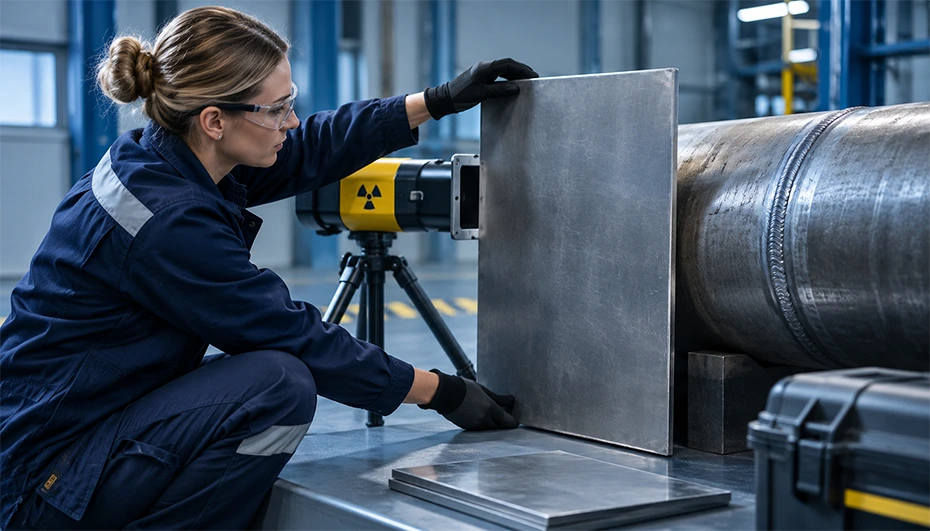
In stationary industrial radiography facilities, specially designed radiation shields are used. These may be constructed using lead sheets available from the Coradika online store. This material forms part of a protective system whose design must correspond to the characteristics of the radiation source and the operating conditions of the equipment.
Why is lead sheet used for radiation shielding?
Lead has been used for many years as a shielding material in medical radiology, industry, and laboratories. This is primarily due to its high atomic number and high density of approximately 11.34 g/cm³.
These properties allow a suitably selected layer of lead to effectively attenuate X-ray and gamma radiation. As radiation passes through the material, physical processes involving the absorption or scattering of photons occur, reducing the intensity of radiation reaching the area behind the shield.
However, it is important to remember that lead sheet does not eliminate radiation completely. The degree of attenuation depends primarily on the energy of the radiation, the thickness of the shielding layer, and the geometry of the entire system.
The most important properties of lead sheet include:
- High density, enabling significant attenuation of photon radiation.
- Malleability, allowing the material to be adapted to specific structural designs.
- The possibility of use in multilayer protective barriers.
- Availability in different thicknesses and dimensions, depending on technical requirements.
- The possibility of preparing shielding components for specialized applications.
Lead is a relatively soft metal, which means that lead sheets used in protective structures require appropriate support and protection against mechanical damage.
The weight of the material is also important. In the case of large-area shielding systems, the load on structural elements and the method of securing individual sheets must be taken into consideration.
Further information about the material’s properties, available forms, and applications can be found on the English-language website dedicated to lead sheets and their industrial applications, including their use in radiation protection and specialized industrial solutions.
Where is lead sheet used in industrial non-destructive testing?
The use of lead sheet in NDT is primarily associated with testing stations that utilize ionizing radiation. Depending on the type of equipment and technical conditions, it may form part of protective barriers, equipment housings, radiographic enclosures, or specialized shielding structures.
Stationary industrial radiography facilities
Specialized rooms intended for X-ray testing are equipped with protective barriers designed to reduce radiation transmission beyond the controlled area. Lead sheet may serve as a shielding layer installed within a properly designed protective partition.
In such structures, not only the thickness of the material but also the continuity of the shielding is important. Particular attention must be paid to sheet joints, corners, service penetrations, and fixing points.
Even a small unshielded gap may locally reduce the effectiveness of the protective barrier. For this reason, the method used to join individual sheets should be specified in the technical design documentation.
Radiographic testing cabinets and enclosures
Industrial facilities using stationary radiographic equipment also employ specialized protective enclosures. Their purpose is to separate the testing area and limit the radiation exposure of people located outside the workstation.
The construction of such enclosures may include steel support elements, concrete, and layers of shielding materials, including lead sheets.
The choice of solution depends on the type of radiation source, radiation energy, beam geometry, and the expected frequency and intensity of equipment operation.
X-ray equipment housings
Lead sheet can also be used in the housings of industrial inspection and measurement equipment.
This includes X-ray systems used for quality control of components on production lines, as well as equipment designed to analyze the internal structure of materials.
A lead shielding layer may be installed between other structural materials, forming part of an integrated radiation protection system.
Custom industrial radiation shields
Some applications require protective solutions adapted to a specific device, workstation, or room.
In such cases, components with defined dimensions and material properties are prepared according to technical documentation.
The ability to select individual lead sheet dimensions facilitates the implementation of projects in which standard sheet sizes do not meet the structural requirements.
Selecting lead sheet for NDT radiation shielding – which parameters matter?
One of the most important stages in preparing a radiographic testing station is determining the required shielding parameters. Material selection should be based on calculations that take into account the properties of the radiation source and the expected operating conditions.
There is no single universal lead sheet thickness that provides adequate protection in all industrial applications.
When designing radiation shielding, the following factors are taken into consideration:
- Type of radiation source – an X-ray generator or a gamma radiation source.
- Radiation energy – which affects the ability of radiation to penetrate shielding materials.
- Equipment operating intensity – the number and duration of radiation exposures.
- Distance from the radiation source – an important factor affecting the dose rate at a given location.
- Purpose of adjacent rooms – particularly how frequently and for how long people may occupy them.
- Shielding structure – the type of supporting surface, arrangement of components, and methods used to protect joints.
In the case of high-energy radiation, using lead alone is not always the most practical or economical solution. Concrete shielding or structures combining several materials may sometimes be more suitable.
The selection of an appropriate protective barrier should be carried out by a competent specialist on the basis of radiation shielding calculations.
It is also important to distinguish the actual thickness of lead sheet from the lead equivalence used when comparing different shielding materials. The lead equivalence value depends on the measurement conditions and radiation characteristics and therefore should not be interpreted separately from the technical documentation.
Installing lead sheet – structural requirements and common mistakes
Correct installation of radiation shielding requires consideration of both the properties of the material itself and the structure to which it will be attached.
Lead sheet is characterized by significant weight and relatively low rigidity. For this reason, it should not be treated as a self-supporting structural element. Depending on the project, suitable backing materials, protective coverings, or supporting structures may be required.
The method used to join individual sheets is particularly important. Incorrectly executed joints may create areas where radiation protection is weaker than originally intended.
The most common problems include:
- Leaving unshielded gaps between individual sheets.
- Inadequate protection of corners and service penetrations.
- Mechanical damage to the material during transport or installation.
- Insufficient support for heavy shielding components.
- Failure to construct the shielding system in accordance with the technical design documentation.
In multilayer radiation protection barriers, the interaction between all materials used is also important. Even correctly selected lead sheet will not provide the required effectiveness if other structural components are installed contrary to the project specifications.
It is advisable to document the successive installation stages, particularly before the protective layers are covered. Photographs, material schedules, and construction documentation facilitate subsequent inspection of the completed installation.
Safety in industrial radiography – radiation shields are not enough
The use of lead sheet represents only one part of a complete radiation protection system. Appropriate operational procedures, supervision of radiation sources, and monitoring of testing conditions are equally important.
In industrial radiography, the fundamental principles of radiation protection include reducing exposure time, maintaining an appropriate distance from the source, and using properly selected shielding.
Depending on the type of workstation, safety interlock systems, equipment operation warning signals, access control, and radiation monitoring may also be required.
The difference between testing carried out in stationary shielded rooms and radiography performed in field conditions is particularly significant.
In the first case, permanent protective barriers may provide the main shielding measures. In the second, greater importance is placed on establishing and supervising appropriate controlled areas and organizing work under changing conditions.
The use of lead sheet alone is not sufficient grounds for considering a workstation safe. The effectiveness of the entire radiation protection system must meet the design requirements and applicable radiation protection regulations.
Regular inspection of the technical condition of radiation shielding is also important, particularly in areas exposed to deformation, mechanical damage, and intensive use.
Standards, documentation and quality of lead sheets used in industry
When purchasing shielding materials, it is important to be able to verify their technical parameters and compliance with the requirements specified in the purchase documentation.
For lead sheets, the most important characteristics include material grade, thickness, dimensional tolerances, surface quality, and documents confirming the properties of the product.
Lead sheets supplied by Coradika are manufactured from Pb99.94Cu lead alloy in accordance with the requirements of EN 12588, which applies to rolled lead sheets intended for building applications.
Depending on the product and order conditions, the documentation may include a type 3.1 inspection certificate in accordance with EN 10204. This document confirms specified material properties based on relevant inspection results.
However, it is essential to distinguish between material quality documentation and confirmation of the effectiveness of a complete radiation shielding system.
A material inspection certificate does not replace shielding calculations, a technical design, or appropriate verification measurements of the completed installation.
For larger industrial projects, it is also advisable to pay attention to material traceability and the compliance of individual components with the approved construction documentation.
Coradika lead sheets – materials for radiation shielding and industrial applications
Coradika Radiation Protection Centre supplies lead materials intended for medical, industrial, and technical applications.
Our product range includes lead sheets in various thicknesses and dimensions, allowing materials to be selected according to specific project requirements. For non-standard dimensions, larger quantities, or specialized applications, individual quotations can be prepared.
In industrial projects, not only the shielding properties of the material are important, but also its weight, preparation method, and delivery arrangements.
A properly planned order helps reduce the need for additional processing and facilitates the preparation of components for further use.
Depending on the project, specific lead sheet dimensions, quantities, and material documentation requirements can be taken into account.
Coradika also offers other materials for protection against X-ray radiation, including lead foil, lead plates, and GK-RTG protective panels. This makes it possible to select materials according to the nature of the investment and the requirements of individual shielding barriers.
For projects involving industrial radiography, ensuring that the ordered material complies with the technical documentation is particularly important. Before placing an order, it is therefore advisable to determine the required thickness, dimensions, quantity, and intended purpose of each component.
Currently offered products can be viewed in the lead sheet category of the Coradika online store, where information about the available materials and their basic parameters is provided.
Frequently asked questions about lead sheet in NDT
Is lead sheet used in all non-destructive testing methods?
No. Lead sheet is primarily used as a shielding material in testing methods involving ionizing radiation. Methods such as ultrasonic testing or penetrant testing do not require shielding against X-ray or gamma radiation.
Is every type of lead sheet suitable for radiation shielding?
The suitability of a particular material depends on its properties and the requirements of the specific project. The mere presence of lead does not guarantee the required shielding effectiveness. Appropriate thickness, continuity of the protective layer, and the construction of the entire shielding system are essential.
What thickness of lead sheet should be used in industrial radiography?
The required thickness is determined through radiation shielding calculations that take into account the type and energy of radiation, source characteristics, and operating conditions of the workstation. There is no single thickness suitable for every device or installation.
Can lead sheet be used to construct the housing of an X-ray device?
Yes. Lead sheet may form part of a properly designed protective enclosure. However, the equipment parameters, radiation geometry, and applicable safety requirements must be taken into consideration.
Does Coradika supply lead sheets for specialized industrial projects?
Yes. Coradika supplies lead sheets for industrial and radiological applications. Individual quotations can also be prepared to take into account the required dimensions, material thickness, quantity, and delivery conditions.
What should you know before ordering lead sheet for NDT applications?
Lead sheet is one of the materials used to construct radiation protection systems in industry. Its application is particularly important in industrial radiography, where properly designed shielding helps reduce exposure to X-ray and gamma radiation.
The material may form part of protective walls, specialized radiographic testing enclosures, equipment housings, and custom industrial shielding structures.
Effective radiation protection depends not only on the thickness of the lead sheet, but also on proper design, installation methods, shielding continuity, and the correct organization of work.
Before ordering, it is important to ensure that the technical documentation specifies the required material parameters and that the intended application meets the assumptions of the radiation protection design.
Coradika Radiation Protection Centre supplies lead sheets intended for industrial and radiological applications, offering the possibility of individually adapting materials to the technical requirements of each customer.